GR20 in Corsica: chronicle of a ‘tour de force’
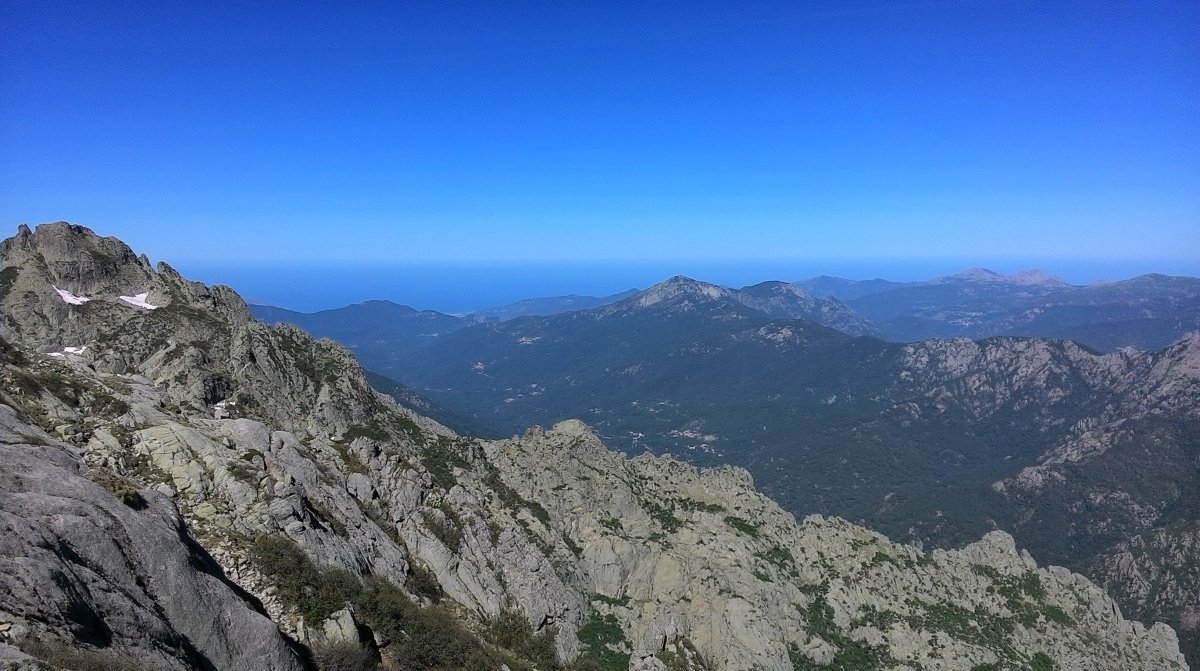
How did a supposedly mind relaxing holiday turn into a military boot camp? The idea behind going to Corsica was to detach my mind from the urban rat race and get some relief in nature, walking, immersing myself in the beauty of the mountains, reflecting, recharging. Camino-style, let’s say. Did not really go as planned, as I found myself stuck into a deadly daily routine which can be resumed in 3 words: eat, walk, pray. Eat everything that appears in front of you, often as fast as you can to make time for walking. Walk from dawn to destination till you hate each single stone you set foot on. Pray to get there in a good weather to avoid soaking your flimsy equipment and then die of cold in the night or slip on some wet rocks during the day. All the rest, including thinking, washing or socializing, became a nice optional. But how did the survival mode kick in? Bad companies, mostly. First of all: myself. You know how bad I am, and I was solo on rough lands at the potential merci of the weather. Then I met Nono, a 50 years old truck driver from the South of France, an ex-ultra mountain runner, who was an authentic walking machine (I was calling him Rambo at the end). Letting him go was probably one of the best moves of the whole trip. Finally, in the last part of the walk, I kept meeting this group of Canadians who were going at about the same pace (which is super annoying for someone who’s seeking solitude). What to do, if not cranking up a notch? But there was another essential incentive for speeding up: the official stages of the trail were way too short for me to call it a day (often I was at the first destination before 10 am already), and on the other end doubling them up was a bit too much (often equating to more than 9 hours net walking time), but still feasible (mind: I said feasible, not easy!). Is there beauty in the number 10 making me wanna finish in 10 days? An inner greed making me wanna face the road with an explosive pace? A need to prove to ourselves (and to others?) who we are (though mules?)? And definitely there is a 18kg load on my back which is not going to disappear until arrival!…. I don’t know the trigger, the only thing I do know is that as the days passed I could feel that a sort of masochistic Nirvana was coming: physical life was harsh, mental life had never been easier “Citius, Altius, Fortius”. At every mountain top climbed, I could see from afar the beach of Calvi getting closer, savoring the moment of when I could finally dive in those clear waters (although you all know that I never swim and hate both sun and seaside days…) Overall, the GR20 is a great experience and for the aforementioned reasons will become a challenge whatever your level is. My wisest recommendation would be to pack light. It’s quite unpleasant for your joints to carry a bag that is ¼ of your own weight! At some points I had pains literally everywhere! The standard GR20 walker is equipped with good shoes, walking sticks, water bottle with pipe connection to their mouths, high tech tent and mattress, lyophilized high nutrition food, sunscreen, synthetic quick drying clothes, a good sleeping bag. Apart from a decent tent I had nothing of the above. My bag was full of clothes and a blanket to survive the night. I wore a hat, long sleeved shirt and long trousers to avoid the sun. Picked up wood stick from the forest when needed. Drank from plastic bottles and carried muesli, dry fruits and couscous. My boots nearly fell apart, but just made it to the end. This is a proof that none of the details matters. Only the total weight that you carry counts. By then end I learned that carrying water from a refuge to the next it’s no fun. In case of emergency there are plenty of sources along the way. Equally, all refuges sell food and have a kitchen: so why taking food with you? You cook in the eve a double portion, you eat the second part of it for breakfast before leaving and you walk without food (except some canistrelli biscuits for the way). A note on food: seen the food on stock at the refuges, I suggest you to forget the concept of a balanced diet. It’s only less than 2 weeks, after all: the rule is simple: a calorie is a calorie…and if there’s not enough fuel, the motor stops! ******
The chronicle: Bastia port – St Lucie de Portovecchio St Lucie – Conca – Bavella To Bergeries Bassetta To Col di Verde To Vizzavona To refuge de l’Onda To refuge Manganu To Bergerie Ballonne To Ascu Stagnu To refuge Ortu di Piobbu To Calenzana. Then Ile-Rousse – Bastia port Day 0: Public transport in Corse is appalling, but I manage to get a BlaBla car lift to the South from a young French couple. I get dropped on the road at St Lucie (1 hour walk from Conca, the southern end of the trail) in a perfect darkness. It’s 1 am. Time to wrap myself in a fleece blanket into the nearest olive field and say good night to the world. Day 1: Googlemaps suggests me some country roads which are pretty awesome, but do not make my life easier. I get to Conca at 8am (super late in the mountaineering world). The climb’s hot but all right. At 12 I am already at Paliri’s refuge and decide to move forward to the village of Bavella. On the way I meet Nono (Dominique), who will become my travel buddy. Fortunately both hostels in the hamlet are full. Having been told that “camping is forbidden, but tolerated”, we find ourselves some nice (and free) spots with a direct view of the Aiguilles de Bavella, a range of steep cliffs of stunning beauty. Day 2: First thing in the morning we meet some local climbers who offer us coffee and especially good advice: avoid the next GR20 stage and choose the alpine variant instead! We are easily convinced and shortly afterwards find ourselves scrambling towards the aiguilles themselves. The rocky path is steep and some passages quite acrobatic (there was a chained way on some rocks with a final jump which I believe was the most difficult spot of the whole GR20), but worth the while. We even manage to gain some time in comparison with the more longwinded official way. The Climb to Asinau’s refuge is also quite though, but only the prelude to the ascent to the following pass, all on slippery rocks. A drizzle was suddenly on us, a storm was cooking up. In such situations “on se dépêche”, no beating round the bush, we got the hell out of there as soon as we could. But the time we were on top the visibility was near zero, by the time we descended up to meadowy pastures, the storm finally hit. Buckets of water and no trees to shelter under. My boots became suddenly heavy as cannon balls, but we not only ended up arriving at the next refuge, but decided to go forward to another Bergerie. Acute pangs on my left foot were the only aftermath of this misadventure. The food in the Bergerie was excellent and most importantly a lot. The slightly wet night was cold but survivable. Day 3: The problems start. A very though double stage is ahead but for some reason I am super late in packing my stuff in the morning and end up leaving at almost 7, whereas Nono is already long gone. In order to catch up I am pushing myself to the limit, first across beautiful woods and meadows (an highlight was the encounter with several sleepy yellow spotted salamanders) and then up a mountain crest, where obviously I get lost. Having found my way again I am now speeding towards the top, the terrain is quite technical and rough with multiple crossings on the rocks from one side to the other of the mountain ridge. Amazing views: on the left: forested slopes and a downhill village perched on the hills; on the right: the contours of high mountain ranges could be seen against the sun light. But that was no time to daydream. I needed to catch up with Nono before the next stage, which was a 5 hour difficult scramble at high altitude to be done in a probably stormy weather. A few minutes before reaching the refuge, I finally recognize his characteristic silhouette. Time for a sweet break at the Usciolu refuge. On the mountain, however, all excesses are debt that must be paid at extortion rates: my legs are now the theater of all sort of possible pains: pangs in the left foot, pains in the knees, bruises on the hips caused by the rucksack. Suddenly I am the one who stays behind. We gain ground fast, leaving some though rocks behind, while progressively a thick cloth of clouds wraps us making path-finding a challenge. Now, the readers must know that there’s not such a thing as a GR20 path. All there is are red and white marks guiding you through a random packing of rocks. If you cannot see the marks (which can happen if you are going from the less beaten direction South-North), then you are going gardening, as the French put it (“jardiner”), which obviously is a bad thing to do. Only thanks to the good eyesight of Nono (and a small help from his GPS app) we could get out of there with relatively minor inconveniences and managed to even rescue a poor fellow who was gardening on some ugly cliffs. We even got to the Prati refuge without being rained on! Having been warned about poor cleaning standards and, more importantly, concerned about the night temperatures at 1800m, we continue to the next refuge which is 2 hours downhill. I was quite exhausted by the multiple aches which came more alive during the downhill, but made it comfortably down. Time to give my joints a deserved rest after a monstrous walk equating to more than 2 official stages. And a beer. Day 4: In a twist of fate, Nono’s alarm clock does not ring, so I now have half an hour of advantage and take it easy through an easy long stretch through forests, then followed by an ascent to the next refuge. The only real difficulty were the many trees that had fallen into the path, requiring strong circumnavigation skills (and a little “gardening”). The main responsible of all that wreckage, Mr Wind, was indeed displaying his full power that day, making any long stop in the forest look unwise. Nono was getting stronger by the day and caught up with no declared issues. After a refueling stop, we were ready to hit the town of Vizzavona across forests and more forests, in a quite unremarkable stretch of the GR20. Day 5: I wake up shivering. A wave of cold had shaken all of us campers all night long. I decide to have an easy day (only a single stage) despite a 6am start. While getting out of the forest, the path was a mild climb offering some wonderful views on the river, with cascade and bathing spots (for a different time of the day…), then there was a steep and long climb through rocky terrain, followed by a descent along a ridge to finally reach the Onda refuge. Nono decides to double up once again. I take an afternoon off and also concede myself a night of sleep inside. It was a good choice, as I find myself with plenty of time to read and to soak in the landscape. Day 6: It’s time for doubling up again, so I start at 5.15, the earliest moment of good enough visibility, taking the alpine variant. The walk on the ridges at such early hours is absolutely stunning. The high round moon on one side, the awakening burning sun on the other. For the first time I feel kinda calmed down and back in control of my own vacation. No one in sight for a good while and some technical passages in the rocks are good fun. How cool to get to the Pietrapiana refuge before 8.30, and find lots of people still waking up! With no further ado, I set off for a gorgeous, but complicated stage to Manganu refuge. All up high, a few stretches with snow I had to do very carefully, a climb on a dangerous looking (but in reality easy-piecy) chainway. Indeed a long day, but the beauty of the views has charged my batteries. The descent on Manganu is draining mostly due to the heat and my knee’s complaints, but once again I am there at a decent time and all of one piece. Day 7: A small initial scrambling is a hard test for my knee, but then the path is mostly flat and rolling. After passing a nice lake the path rises again offering a nice view, then it’s all forest mostly downhill until the hamlet of Col de Verghio. The food shop there was well stocked, so I linger about for longer then usual and get in contact with some other hikers who warn me about the risks of what comes next for me: the crossing of monte Cinto. The spoken truth varies greatly from person to person, but the key message is that it would be unwise to face all that snow without crampons. My boots are quite worn out and I don’t even have walking stick so some doubts creep in on whether my adventure was going to undergo some unpleasant alterations. Should I try to buy some crampons from other travelers? Should I waste the following day by going down to the nearest town and take a shuttle bus to Asco Stagnu? Or should I just go and see by my eyes? Procrastinating the decision to the following day seemed to be the most sensible strategy… I left col de Verghio in the heat of the day. Usual forest to get out of the village, then the path climbs toward the refuge of Ciottolu-moru. Met a couple of funny locals trying to convince me to take a more straight and lower path to the refuge, but gladly stuck to the longer but more panoramic GR20 route (on a crest). Unfortunately my camera is still dry on batteries so the only snapshots I capture are those in my mind. After a mountain pass, it’s then a long downhill, initially very rugged on sharp red rocks which took a heavy toll on my already knackered boots, and then a milder descent through forest which however felt never ending. At about 5pm – my latest arrival time- I am at the Bergerie de Ballonne. The setting is beautiful as I am camping in a valley surrounded on all sides by high mountains. One of which is the one I will be engaging with most of the day tomorrow. Day 8: Having evaluated the comments of various people I met and seen the clear weather, I decide to simply go ahead and check the snow situation on Monte Cinto by myself: I am armed with 2 wood sticks (one of which will sadly break during the descent) and a piece of paper around my neck stating “J’achète crampons” (I buy crampons). Little I hoped that this would have worked and I was now resolved to tame the snow in any case, but to my astonishment after less than 2 hours of climbing up, I already found some sellers. One pair of crampons heavier and 20 euro lighter, I was now as confident as fuck. For the first time in my life feeling even over-equipped. The path continues on rocks of all sizes. In less than 2h30min I am at the top, affording a break with some people met at the Bergerie. We then start the descent only to find out that the snow is actually very little on the GR20 path, whereas most of the people going the other way simply did not see the path and ended up just following a most direct route all in the snow! The descent is long but we go fast as hell, sliding on the gravel or helping us with our hands through the rocks. We arrive in Asco Stagnu early enough to recharge our batteries for the next day. And to resell the crampons. Day 9 was big and involved the use of my hands a lot. Leaving Asco the path climbs up very steeply to a first pass, then you walk on the other side of the mountain and reach a second high point, before descending through the beautiful valley of the Spasimata river. The stage culminates with the crossing of the hanging bridge over the river, before then reaching the refuge of Carrozzu. I left Carrozzu at around 1030 feeling in top form. In no time I was climbing another mountain and jumping through technical passages along a crest, affording also some times for short pauses. The subsequent descent is long and hot but at 3pm I have already reached Ortu de Piobbu. Day 10: A 5,30 departure for an all downhill stage to Calenzana that is a children’s game. At 9am I am already down, even if I afforded a long pause to get in touch with some wild mouflons. Nice views to Calvi’s beach. In Calenzana I easily find a lift from a local 80 years old to Ile-Rousse, where I spend an half day exploring the contrast between the basic GR20 life and the swanky vacation life that people lead on the posh coastal towns. Then onward to Bastia’s port and the ferry transfer to Genova (I love ferries). Train home just in time for lunch.