A treatise about compost
Or...how to do it the lazy way....
To compost or not to compost? This is The Question... in the permaculturists hit parade. Nowadays the fashion is to say that composting is so NOT glamorous... "just let nature work for you using cover crops" ...or some other similar mantras like "simply throw residues back on the soil directly" are not uncommon.
Let 'em talk.
The reality on the field is: when planting time comes, it's nice to have a decent amount of decently made compost to amend your soil and feed your veggies.
In this article I want to outline what my approach to compost is, including how to minimize the work involved, maximize the quantities and consistently obtain a good quality without going crazy...or - even worse - going "professional" :)
There's only 3 words that summarize success when talking compost: Quantity, quantity, quantity.
Quantity because you need a lot of it
My context is self-sufficiency agriculture at a scale 10 times larger than a typical allotment (and at least 10 time smaller than a commercial operation). A scale still manageable in little time only with handtools but in which we don't think in tens of kilos, but hundreds of kilos of crops to be produced (... and at the same times not tons)....We don't talk of tens of square meters, but hundreds of square meters.. (and forget the hectars).
This equates to a need of compost of up to 10 cubic meters per year.
It is clear that in this framework, the archeypical image of a little compost box in which we throw kitchen residues is a joke. We need to scale it up. And forget kitchen scraps, too, the majority of your raw materials comes from the vegetation growing all around you!
Quantity because in this case it rhymes with quality
Physics tells us that the biggest the pile the better is going to retain the heat it generates and therefore the better the decomposition will be. In practical terms, your piles of organic matter simply need to be enormous and you should make more than one. Having to collect large quantities of materials (branches, grasses, herbs, hay, leaves, chicken litter, semiwoody shrubs, brambles etc etc) you will naturally tend to introduce a lot of variety (another key word) both in terms of materials (notably in the famous carbon to nitrogen ratio, of which however I do not recommed you worry too much about) and in terms of water content (last but not least of the keywords..of which you definitely need to worry about) of these materials. Yes, water content is the main factor which will determine your success. Too little of it and the material does not decompose, too much of it and it turns into a stinky sludge (anaerobic putrefaction).But of this we'll talk later...
Quantity because it simplifies your operational strategy.
Remember those who told you to regularly mix your compost with a pitchfork? Well, that's part of the kitchen-box small scale thinking paradigm.
Forget about that.
Having a lot of material which is aside decomposing allows you to work much less. Big piles of different ages mean that you can go there at any time and pick up the amount of compost you need without worrying of having to accelerate the process by mixing with a pitchfork. Why putting a lot of work (and break your back) in trying to speed up a process when you can simply increase residence time of your materials in the system? Slow composting also means higher compost quality (in nature slower often is better..) and less losses of carbon dioxide to the atmosphere.
Water content: how to adjust it
Water in compost piles is an art (at least for me).I never know how much water to add to a compost pile (whose composition is always different) , but here is some advice:
-Keep a water container near the place where you pile up because water is heavy to transport
- Remember gravity (!) and throw water on top of the material. it will then seep down gradually.
- Sprinkle rather than throw all together.
- Add water to each layer, rather than all at once at the end.
- In the future, the water addition in compost piles can be an important item of counterfoil research to carry out at the farm and share with my followers :)
Once the pile has started (yes, I suggest to create piles of several cubic meters all at once), during the first days I check the core temperature with a long thermocouple. If it is high enough (let's say around 40C or more) it means the reaction is raging and water content is ok.
From time to time (after weeks/months) I go and check the piles again... and here is where I do some pitchfork mixing which I see more as a one-off water rebalancing operation (rather than a regular practice to improve aeration) . The mixing is not limited to a given pile, but (and I would say surtout) happens between different piles. Some piles maybe too dry, other too wet, so mixing them can rekindle the composting reaction by rebalancing water content. Also by merging two piles together, the mass of the pile is increased, which is always good.
Note: this mixing happens late, after the material has already partly decomposed so there's less of it and it has already been broken down so the operation is much less tiring than the typical mixing suggested for fast composting. Such operation is really important in my opinion because it enables to effectively fix the "water problem" and (in my experience) always obtain compost of good quality.
"Fertimulching" and the "compost spectrum"
Those new words enable to reframe compost on broader terms.
Assuming your compost did not rot because of too much water, we can classify compost based on its degree of decomposition. On one end of the spectrum you have fully decomposed compost (high quality, fully mature compost), on the other one material that has not decomposed at all (mulch).
Fully mature compost amends the soil and is a fertilizer, whereas mulch is mulch.
But you can also use your compost when is not fully mature and do fertimulching: fertilization and mulching at the same time. I use this a lot. In autumn, part of my veggie garden is covered with a thick multilayered mulch to suppress weeds and enrich the soil and I found that using not fully decomposed compost as the bottom layer works well. I like to believe that the soil microorganisms take over the decomposition process of such compost layer and stay happy and well fed.
The brightest of my readers will have understood by now that the interest of using immature compost is two-fold:
- Firstly, it can be even more useful in the garden than mature compost under certain circumstances because its undecomposed content can become food for the soil life. More research is needed on this front. I think the key resides in having a material that is available to be digested by the soil microrganisms at an optimal rate (a sweet spot between pure mulch - which is too slow/difficult to digest - and mature compost - which is already fully oxydized so has less chemical energy potentially avaialable to soil microrganims)
- Secondly, using immature compost reduces the average composting time of the materials we have in our piles onsite. So our materials not only can be put to use better (in a way that more fully exploits their potential), but faster.
The next level
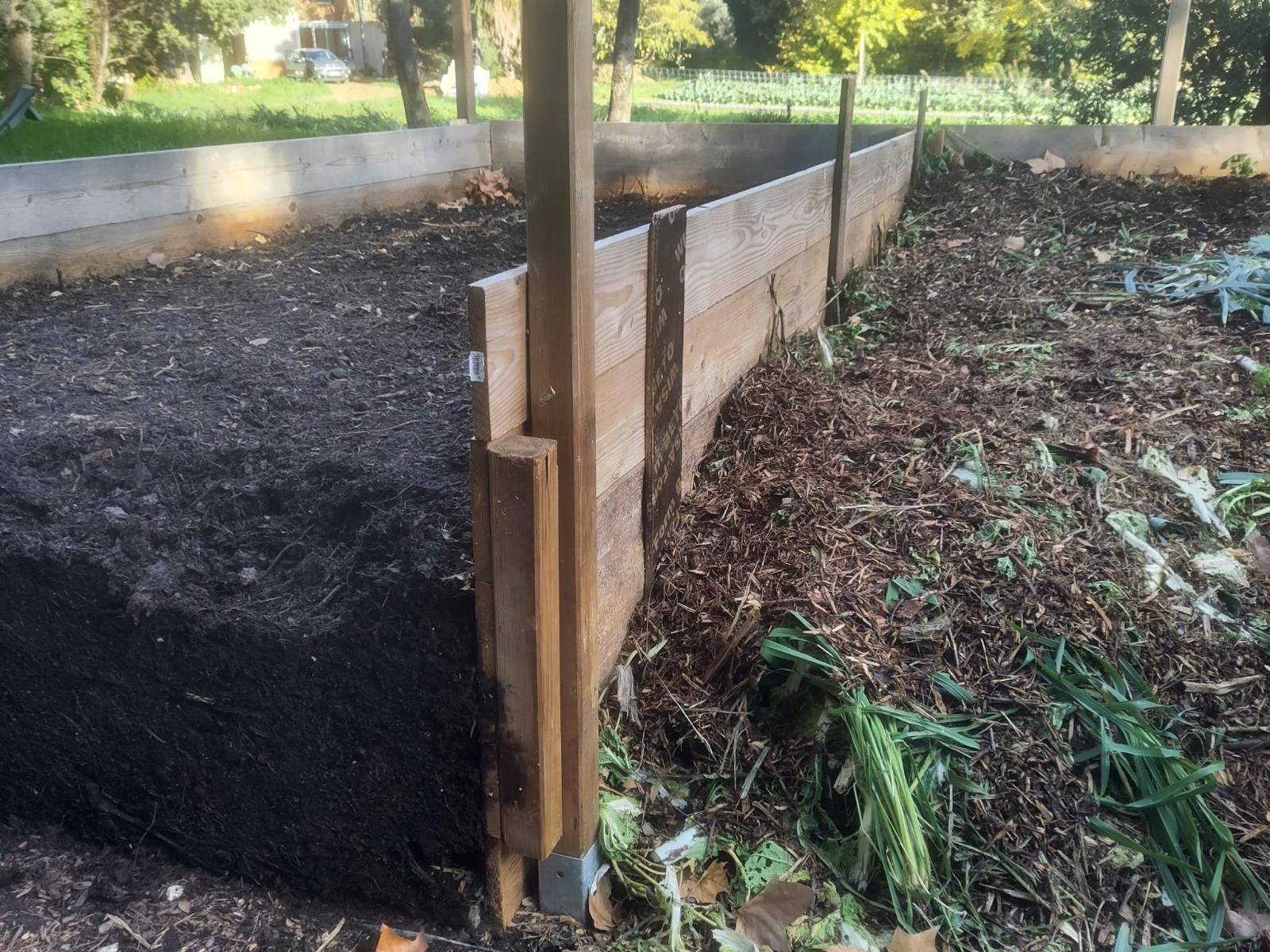
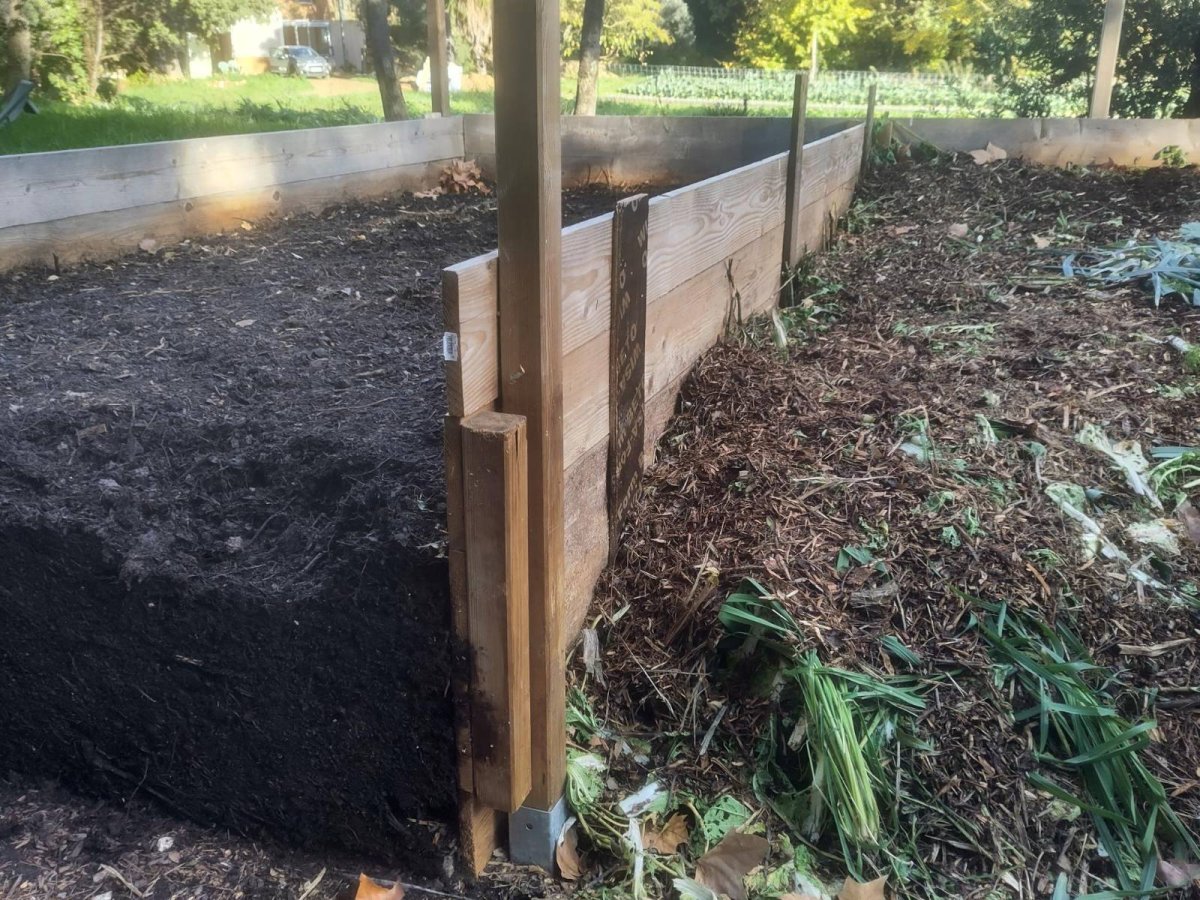
Here is an example (see picture at the bottom) of the composting setup of a small commercial farm in France, at a friend of a friend's. This is how to scale it up in a rational way. The infrastructure is fancier and the additions of raw materials and water more controlled, but the basic principle of operation is quite similar: mix only once. The issue I have with this approach is that the woody part of the biomass is under the form of woodchips. Woodchips obviously work great, but do we really need to waste gasoline on something that we compost? Again, we don't. I want to fine tune a similar method where we compost branches instead of woodchips.. This will require a substantial increase of decomposition time. Will it be worth it?
What about shit
At this point you may philosophically wonder: why not adding shit (cows, chicken, goats, humans) directly to the garden and forget about compost? .. and all my fine reasoning is falling to pieces. Other than referring to what I read on books about compost feeding (and building) the soil long term and manure giving a short term boost, I realize that I must conduct a more scientific direct research on the topic.
What I can say is the following. My primary goal is to add organic matter to the soil and build it year on year. You cannot do it with shit, which is very concentrated in nitrogen.. so you need to add in very small quantities. You can do it with compost whose main function in my opinion should be amendment of the soil rather than crop fertilization.
My direct experience points in the direction of limiting as much as possible direct fertilization with manure. The ideal to tend to is:
- Fertilization via water solution (fertigation) - using various compost teas or diluted urine... to have a fast intake from the crops, targeted application of the solution and total control of the operation
- Soil amendment with compost (bottom interface) and mulch (at the top).
Shit is still very useful as an ingredient in the compost pile. In my experience it boosts the decomposition and yields a final product which appears to be better (more brown, more flowing... it just looks great..somewhere you cannot help but puts your hands into...).
A philosophical conclusion
We cannot understand most of the phenomena that happen in living ecosystems. But we can follow the principle that "Life begets Life": a living system- whether the soil or a compost pile will try to "heal" itself and generate the conditions for life. We are there just to make life easier for them :)
My key strategy for that is "Diffusion rather than concentration: in space and time". Life operates within certain ranges of chemico-physical composition so always mix as many ingredients as possible (diversification) in as smaller percentages of each as possible (dilution) and intervene on systems at different times (balancing) in order to interact with them over time and doing small adjustments rather than big interventions.