"All mulch is equal, but some is more equal than others"
The title is just the Orwellian way to say that..
Not all mulch is created equal
As I briefly mentioned in the previous point, I don't like buying straw or hay (from producers fueled by fossil capital) anymore because I see it as a shortcut that can be easily replaced by producing it by myself.
I do have the chance to have enough land for that, so this year I'm giving a go in experimenting the total self-production of biomass. Is it possible in terms of quantity that can be harvested and amount of work required? Is the effect of the biomass good for the soil? Some say, for instance, that walnut leaves are allelopathic and oak leaves too acid...but I'm a taker of both, because mulch beggars can't be choosers...)
Even more importantly woody biomass (woodchips in particular) have a qualitatively different effect on soil regeneration. They contain much more lignin than straw and hay and have a much higher density. From some studies I've seen and from my own observations I've come to the idea that woodchips can be converted quite fast into humus by the combined work of plant roots and soil microrganisms.
I'm still not fully a fan of the approach requiring massive additions of woodchips on the surface of the soil, but I am doing some experimentation on that. One problem that I see doing that is purely practical: it's very difficult to produce all those woodchips with the semi-professional machines that a typical permaculturer can afford. The other problem is more fundamental: if by mistake all this non-decomposed organic matter gets mixed too much with the soil instead of staying on the surface, there's a concrete risk of "blocking" the soil itself. All the energy of the soil would go on decomposing the stuff at the detriment of plant life which would in turn trigger a downward spiral... Since the C/N ratio of woodchip is not balanced I also risk triggering the feared phenomenon of nitrogen famine and stunt the growth of the veggies.
So my preference (and my only possibility, if I need to self-produce all my mulch) is to use everything: leaves, woodchips, wood residues, grass clippings, straw, hay... mixing those materials to some extent can also help balancing carbon and nitrogen.
Some findings:
- Big trees near the garden are the easiest source of mulch. Walnut, willows, oaks and poplars = big trees = a loooot of leaves. I managed to cover large parts of the garden with those
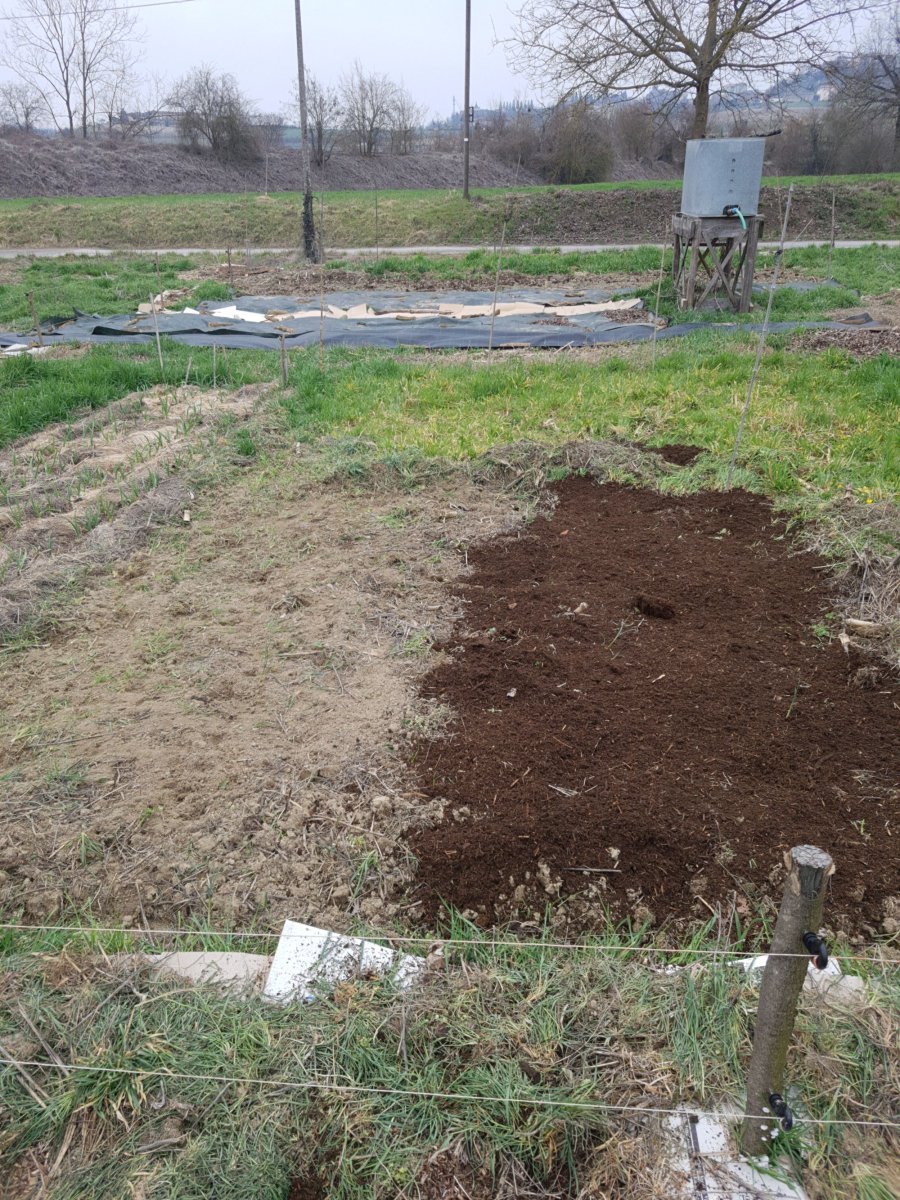
- Woodchips are sometimes a lot of work to make. Best to choose the right trees: dogwood, hazel, willow, elm, maple (straight stuff).. elder trees, mulberries and other very crooked stuff is hell. Nonetheless it's possible to obtain huge quantities of it from shrubs around the house. This year I dedicated about 70 square meters of garden to large additions of woodchips to observe the effect on the soil in the next years.
- I used a lot of walnut and oak leaves, so I need to monitor if veggies grow well in it
- Hay made with a schythe will be the main source of organic mulch from now (spring has started and I stopped woodchipping to respect the trees). As early as mid March, I've started to do my first cuts on meadows where the grass was already long.
- I'm now also looking into really low quality brushwood to turn into workable mulch via composting...
Happy scavenging!