Demotivational speech (update)
Four years ago I had the honor to be invited by a friend professor to the university of Leuven-la-Neuve to give a guest lecture in a "critical management studies" module. I spoke about my ex-career and exposed the reason on why I quit my brilliant job.
His contract was not renewed and we never got feedback on the lecture, apart from some shocked looks from the students. I guess I can define that a success and a sign that I was demotivational enough, (hopefully) wrecking up the life outlook and career aspirations of those young bright minds.
Today, I've revamped the presentation because I've been invited by another friend professor in Italy to go demolish young science students in Milano.
I am sure that the most assiduous fans of mine have already looked at my video from 2019, so I'm going to post here only the relevant updates.
Worsening of the global ecological situation (2023 vs 2019)
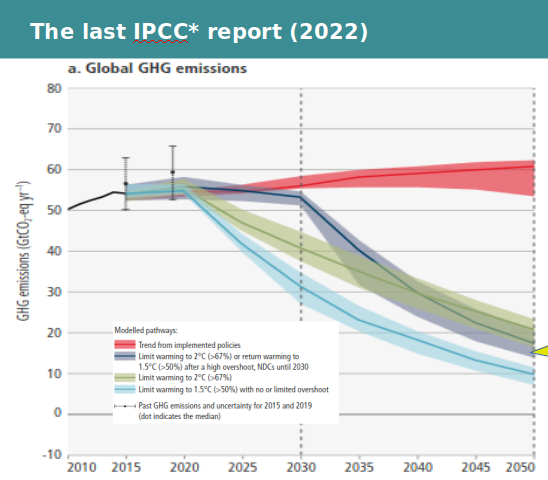
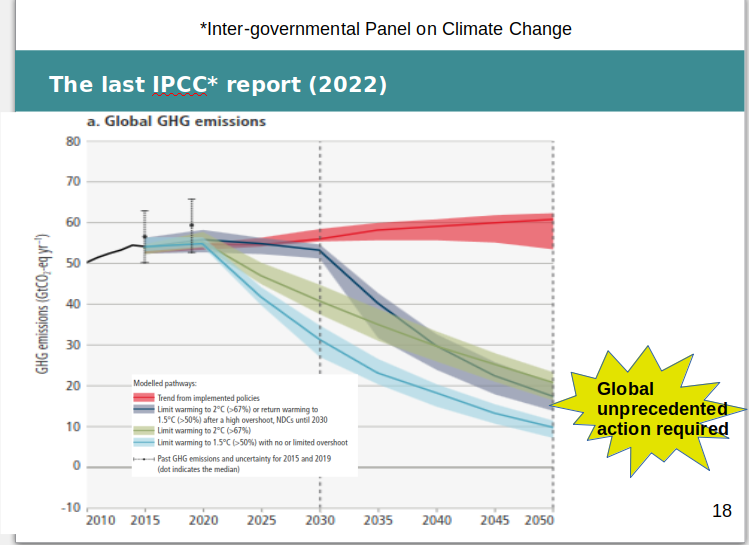 Expected emission trajectory (red) vs the pathways to reduce emissions to "safer" levels
The new plot of expected emission vs what would be required, apart from showing that the last 4 year have continued "as usual", seems nothing new from the 2018 one. However the comments from the panel are much bleaker. In 2018 they were saying: “In pathways limiting global warming to 1.5°C CO2 emissions are reduced to net zero globally around 2050”. They were still open to the hypothesis that the goal of 1.5 was achievable (although for the Global North this would mean a 60-80% decrease by 2030).
Here's their topline in 2022: "Projected global GHG emissions from NDCs announced prior to COP26 would make it likely that warming will exceed 1.5°C and also make it harder after 2030 to limit warming to below 2°C." So 1.5°C is gone... and the best we can aim now is 2°C which is most likely not a stable scenario...
I don't know if I am saying something relevant for your lives in general or not..but I guess the takeout message is that things are going worse (not surprising, as we still haven't dropped the growth economy in the last 4 years) and that scientists seem to become more depressed and pessimistic. Which is normal.. I guess seeing how things are going... At the same time, reading of what I interpret as a note of "fatalism" and "defeatism" in those reports is sad because it reminds how fascism is just around the corner. When it's too late, we'll just give up, states will become (and are already) more autoritarian and inequalities will be deepened by the use of force and technology.
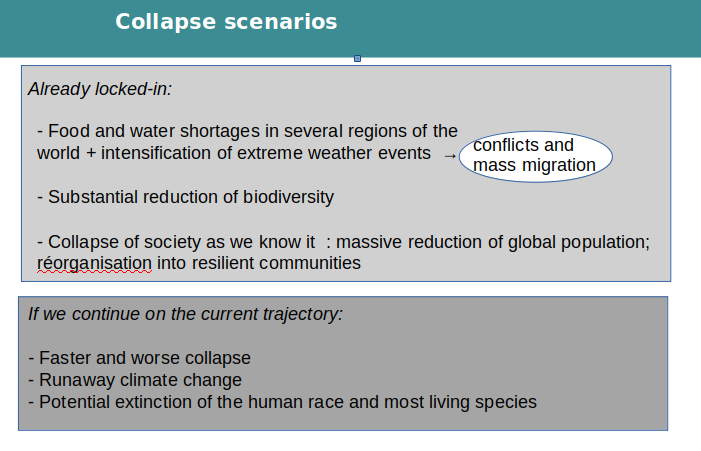
In terms of collapse scenario, the stabilisation of temperature to below +1.5°C is out of the picture, does this change something for our outlook to the ecological struggle? Does it mean we have lost and there's no way to avoid runaway climate change?
I guess nothing changes, even becuase I've already long been convinced that reality is much worse than these reports say, due to the "conservative" bias of the IPCC so well explained by some other less mainstream groups ( check out David Spratt from the Breakthrough institute, for instance[*]).
However, what's clearer and clearer is that we are not saving the world nor humanity here...I believe the reason for action in the ecological sphere is becoming further and further intersectional and political. Reorganizing from the grassroots may not do a significant difference for ecology, but it definitely can make a big difference for the political structuring of our society in the next decades. We are resisting the inevitable rise of post-collapse fascism. We fight for social rights, solidarity, justice...
Which is why I've added this slide at the end of my gloom and doom introduction of the global context:
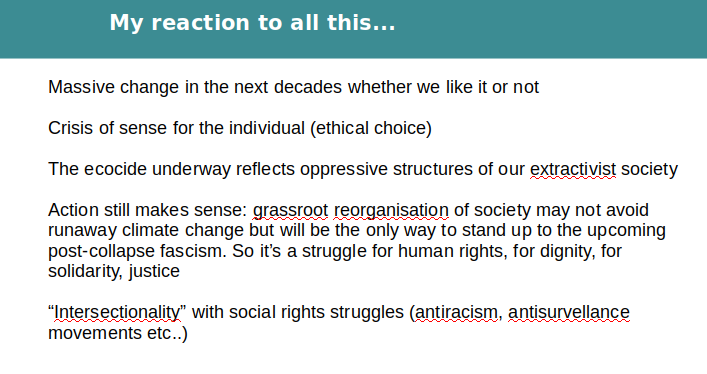
My personal change (2023 vs 2019)
I've been mainly involved in XR in 2019 and 2020, then my situation changed...the squatting experience, the involvement with refugees, the community trial in the countryside,and now the farmer life and the studies to become a sociocracy trainer... let's say it's being quite a ride and that I have definitely some material to try to inspire and convince those (poor) students that there's a world out of work and that it sparkles with light and life... (at least until we all die in a nuclear war)
[*]quote from D.Spratt's article:
" Another fundamental problem is the approach to risk. IPCC carbon budgets regularly include risks of failure (overshooting the target) of 33% or 50%, that is, a one-in-two or one-in-three risk of failure. Thus a 2-degree carbon budget with a 50% chance actually has a 10% risk of ending up with 4 degrees of warming, which is incompatible with the maintenance of human civilisation.
These are risks of failure that no government or person would agree to in any other aspect of life — whether it be buildings and bridges, safety fences or car seats — where acceptable failure rates are tiny fractions of one per cent. The fact that the IPCC incorporates in its core business risks of failure to the Earth system and to human civilisation that we would not accept in our own lives raises fundamental questions about the efficacy of the whole IPCC project.
If low risks of failure are taken as a starting point, then in an instance the so-called “carbon budgets” for 1.5 and 2 degrees reduce to zero. They cease to exist because they are an artifice of this appalling gamble with risk, and with them disappears any notion that “net zero 2050” is a soundly based policy aim.